Type in Chinese
1. Please reload the browser, OR
2. Open (http://www.easychinesetyping.com) on New Browser 请稍候。中国的翻译是载入中 …
Please wait, Chinese Language Translation is Loading … You can now type in Chinese in this text area …
Useful Hints for Typing in Chinese
-
Typing English words in the text area above will convert them into the closest corresponding Chinese words or script.
For example, typing "ni hao ma?" will be transliterated as "你好吗?".
- Press Ctrl+G to switch between English and Chinese.
- Use
backspaceor click on any word to see additional options in the dropdown menu. - Once you've finished typing, you can email the text to friends and family.
- Click the Share button ( ) to send your Chinese text via WhatsApp, Facebook, Twitter, LinkedIn, and Email.
- Simply copy and paste to post on Facebook or Twitter, or to format the text in an editor like Microsoft Word.
- Browse your typing history – Click the Save icon ( ) below the typing area to view and restore your previously typed Chinese content.
- Distraction-Free Mode — Click the ( ) icon below the typing area to enter a full-screen typing experience without any ads or distractions.
- If you don't have an internet connection and would like to type in Chinese offline, you can easily do so by installing our software for FREE. Visit this link for detailed instructions. Once installed on your PC, you can type in Chinese on Facebook, Twitter, WhatsApp, Word documents, and even in emails.
Yes, it really is that easy. There's no need to remember complex Chinese keyboard layouts or spend hours of your valuable time on typing speed tests. Typing is as simple as speaking.
Chinese Language
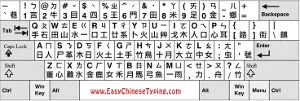
Fig 1. Simplified Chinese (Mandarin Chinese Keyboard Layout).
Chinese (中文 Zhōngwén; 漢語 Hànyǔ) belongs to the Sino-Tibetan language family [1], which is the world's second-largest language family after Indo-European. Chinese is classified within the Sinitic branch [2] and encompasses multiple major varieties including Mandarin, Cantonese, Wu, Min, Hakka, Xiang, and Gan.
Standard Chinese, based on the Beijing dialect of Mandarin, is spoken by over 1 billion people worldwide, making it the world's most spoken language. It's the official language of mainland China and Taiwan, and one of the four official languages of Singapore.
Chinese is written using Han characters (Hanzi 漢字) [3], a logographic writing system where each character represents a word or meaningful part of a word. There are two standardised character sets: Simplified Chinese (简体字) used in mainland China and Singapore, and Traditional Chinese (繁體字) used in Taiwan, Hong Kong, and Macau [4].
Hanyu Pinyin (漢語拼音), officially called the Chinese Phonetic Alphabet, is the standard romanisation system for Mandarin Chinese [5]. Developed in the 1950s and officially adopted in 1958, Pinyin uses the Latin alphabet to represent Chinese sounds, making it easier for learners to pronounce Chinese characters correctly.
Chinese is a tonal language, where the same syllable pronounced with different tones has completely different meanings. Mandarin has four main tones plus a neutral tone. For example, mā (妈 mother), má (麻 hemp), mǎ (马 horse), and mà (骂 scold) all use the same base sound but mean different things.
The Unicode Standard encodes both Simplified and Traditional Chinese characters, supporting proper text rendering across all digital platforms. You can use the Pinyin input tool above to type Chinese characters by entering romanised pronunciations—for example, typing "ni hao" produces "你好" (hello).
About Our Chinese Typing and Translation Software
How to Integrate English to Chinese Transliteration?
Google Transliteration (Google Input Tool) provides phonetic typing from English to Chinese.
Although the official tool has been deprecated, you can still integrate similar functionality using community-maintained packages. Below are practical methods to implement English-to-Chinese transliteration on your website or application.

Frequently Asked Questions (FAQs)
References:
- [1] Glottolog 5.2. "Sinitic Language Family". Max Planck Institute for Evolutionary Anthropology. Retrieved from Glottolog: Sinitic
- [2] Glottolog 5.2. "Mandarin Chinese". Max Planck Institute for Evolutionary Anthropology. Retrieved from Glottolog: Mandarin
- [3] Unicode Consortium. "Unicode CLDR - Languages and Scripts: Chinese". Retrieved from Unicode CLDR: Chinese Scripts
- [4] Unicode Consortium. "Unicode Standard Annex #38: Unicode Han Database (Unihan)". Retrieved from Unicode: Unihan Database
- [5] International Organization for Standardization. "ISO 7098:2015 - Information and documentation — Romanization of Chinese". Retrieved from ISO 7098:2015
 Sambhu Raj Singh ·